metacool Thought of the Day

Nissanmizuno2

"When you're making something of high quality, you have to polish it a certain number of times.  This is actually a number of trial and errors.  When you think about how much you can polish something in a four-year development period, you're talking about how many times you can do trial and error and then speed becomes the defining factor.  When you all share that speed as a team, you can polish a car like never before.  It's that simple, really."
                                – Kazutoshi Mizuno, Chief Vehicle Engineer, Nissan GT-R

I love this insight of Mizuno's, because it speaks to one of the fundamental aspects of design thinking as it  relates to the process of innovation: iterate, iterate, iterate.  I often relate "business by design" to "business as usual" by using a sporting analogy:  business as usual is about efficiency and accuracy, about swimming as fast a race as one can.  And there's a time and a place for that.  Business by design, in contrast, would be a swim race where you where rewarded based on the number of laps you could get in within a certain amount of time.  You want to do lap after lap, because with each stroke through the water, you gain the opportunity to learn something new, to try a different approach.  The sum of all those small learnings and insights — together with the occasional big leap — is what ends up being called innovative behavior.

But I like Mizuno's notion of polishing more than I do that of laps.  Lather, rinse, repeat.  Keep trying for perfection even though you know it will never come in a full sense, but with each try some new learning emerges.

So how quickly can you polish and iterate?

quote source: Gran Turismo TV, "The GT-R Legend Inside Story"

Innovating, not innovation

At IDEO (the firm I work at), we recently held a "chain reaction" event across all of our offices:  Shanghai, Munich, London, New York, Boston, Chicago, San Francisco, and Palo Alto.  Self-nominated teams in each office crafted their own chain reaction experience, each of which was triggered by another chain reaction experience sitting in another office.  It all took place on one Friday morning…

Why?  Because… just because.  Because it is fun.  Because it is there.  Because cultures that play on a routine basis are more likely to be innovative routinely.  Because the question "how can we be more innovative?" is better couched as "how can we be more comfortable acting in innovative ways?".  It's about encouraging a behavior, not a thing.  A verb, not a noun. 

Since innovative behavior is about both the practitioner and the environment they live in, why not do something that buffs both?

You can see more about this grand world exercise at IDEO Labs

PS:  the "trick" in the NYC/SF transition was done using a body double 

What is design thinking?

Here's a great interview with Roger Martin, Dean of Rotman.

He provides a very crisp definition of what design thinking is about.  Design thinking is about creating better things, while traditional analytic thinking is about choosing between things.  We need both, but surely the world would be in a better place if there was a bit more design thinking in play out there.  Which is why we now have places like Rotman and the d.school and the entire design thinking movement.

By the way, if you don't read Rotman magazine, you should.  And if you haven't read Martin's book The Opposable Mind, go out an grab a copy today!

On Anathem and points of view

If you’re a frequent reader of metacool, no doubt you’ve noticed that I’ve had a book parked on the nightstand for more than a month.  I’m pleased to report that I’ve spent the past month reading Anathem, the latest work by Neal Stephenson.  Actually, you don’t just read a Stephenson book like Anathem, you inhale it, such is the totality of the environment he’s able to  create.  Without giving away the plot — or even pretending to be able to summarize its complexity — let’s just say that the book explores topics as a varied as the space-time continuum, the concept of time itself, and the the notion of topology as destiny, all delivered in a tasty package of vivid characters and zesty dialog.

One of the many reasons I like Stephenson’s writing is that I always learn something about the process of bringing cool stuff to life.  One of the characters in Anathem is a very large clock.  The clock was designed a long time ago, and was built to last.  I admire the following passages from page 94 of the book, which are spoken by an engineer and a monk of sorts discussing the design of the clock, because of how to they speak to the concept of point of view:

“This just isn’t the way to do it!”

“Do what?”

“Build a clock that’s supposed to keep going for thousands of years!”

“Why not?”

“Well, just look at all those chains, for one thing!  All the pins, the bearing surfaces, the linkages — each one a place where something can break, wear out, get dirty, corrode… what were the designers thinking, anyway?”

“They were thinking that plenty of avout would always be here to maintain it.  But I take your point.  Some of the other Millennium Clocks are more like what you have in mind: designed so that they can run form millennia with no maintenance at all.  It just depends on what sort of statement the designer wanted to make.”

Exactly: a point of view is the set of conscious constraints a design thinker adopts in order to make a specific statement.  In the case of Anathem’s Millenium Clock, it is about a design which can be complex and nuanced because of a ready supply of labor to run and maintain its myriad mechanisms.  Another point of view could have been to design a very simple clock with few moving parts, the extreme version of this point of view being a sundial.

I submit to you that, as a rule, things that are remarkable are born from a strong point of view.  Those that are not remarkable are often the result of a muddled point of view, or no point of view at all.  Having a point of view requires making choices among many possible alternatives.  Having a point of view means having a vision of what good looks like as a means to make those choices.  You can feel it when something was created with that vision in mind.  And when that vision was not in play, you can feel the lack of it.

Creativity and the Role of the Leader

Last year I participated in a Harvard Business School colloquium titled Creativity, Entrepreneurship, and Organizations of the Future.  I had a great time contributing to the conversation there and learned a lot, too — in other words, it was a classic HBS experience (I really love the place).

The October issue of Harvard Business Review has a summary of the colloquium written by professors Teresa Amabile and Mukti Khaire.  It is titled "Creativity and the Role of the Leader", and it’s available for free right now on their site.  I’m quoted in it, and so is my blogging and teaching buddy Bob Sutton, among others.

Here’s my favorite portion of the article:

By the colloquium’s end, however, most attendees agreed that there is a role for management in the creative process; it is just different from what the traditional work of management might suggest.  The leadership imperatives we discussed, which we share in this article, reflect a viewpoint we came to hold in common: One doesn’t manage creativity.  One manages for creativity.

What do you think?

Making green red: the ALMS Green Challenge

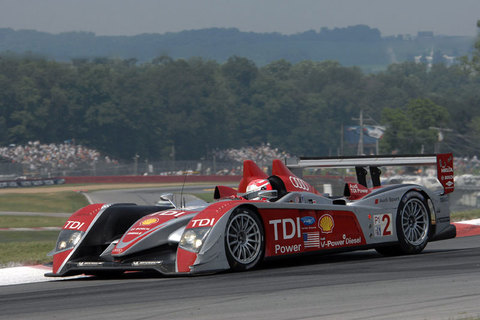
Audi_on_track_2_lg

This past weekend I watched some fantastic racing at Road Atlanta courtesy of the American Le Mans series.  Audis were dicing with Peugeots, Ferraris with Porsches, Porsches with Acuras, and Corvettes with Aston Martins, among other marques.  All of it awesome, technology-centric racing put on by the American Le Mans Series (ALMS).

What made this particular running of Petit Le Mans unique was the debut of something called the Green Challenge.  An innovative behavioral incentive program developed jointly by the ALMS, the US Department of Energy, the Environmental Protection Agency, and the Society of Automotive Engineers, the Green Challenge allows racing teams to score points for sheer speed and for energy usage and carbon footprint.  Teams are evaluated on the total greenhouse gas life cycle of the fuel type they use in the race, which could be cellulosic ethanol, bio-diesel, and ethanol/petroleum blend, or a hybrid internal combustion/electric source.  For the gearheads among you, the following formulas are used to evaluate Green Challenge performance:

  • Performance Energy Coefficient (the amount of energy used):  [total normalized fuel consumption during race] \ [1,000,000]
  • Greenhouse Gas Coefficient (the amount of greenhouse gases emitted): 3 * [ (upstream C02) + (downstream C02)]
  • Petroleum Fuels Displaced: Y * [ (upstream petroleum energy) + (downstream petroleum energy)]

As a general rule, competition is good for spurring on innovation.  From high-minded endeavors such as the X PRIZE, to the (very scary) technological leaps seen during WWII, high stakes seem to breed a combination of focus and access to resources which help support innovative behavior.  In the parlance of Ways to Grow, competition helps set the context for revolutionary innovative outcomes.  To that end, here’s what Margo Oge, Director of the Office of Transportation and Air Quality at the EPA, has to say:

Automobile racing spurs innovation in safety, performance, and now, we are happy to say, clean technologies.  Racing is the ultimate test track.

Amen.

I admire this high-minded, innovative approach on the part of the American Le Man Series.  Rather than take a pessimistic, let’s do less-bad approach to racing — which would have gone in the direction of greatly restricting fuel consumption, which is terrible for competition — they chose to pursue an optimistic, pro-fecundity and consumption approach to being green.  As Bill McDonough has shown us, we can make a paradigm shift to a system where inputs and outputs flow in ways that enable consumption without harming our environment, rather than assume that all consumption must trigger an increase in entropy. This initiative is only the tip of the iceberg, but it is a fantastic start.  I tip my hat to the leadership of ALMS.

And the title of this post?  It refers to an article I wrote for NZZ Folio a year ago, called  Who will be the next millionaire?  My point then was that we need to find ways to go green while going red, which is my code for maintaining our ability to enjoy things that are sexy, fast, and cool.  I still believe this is true, and that we are in the early days of making green tech and clean tech sexy.  This is one of the reasons behind my new blog Unabashed Gearhead Gnarlyness — it’s an exploration of what makes red red.

For those of you who didn’t catch the race, here’s the last lap.  Allan McNish is a hero, a pure racer.  Here is a drive worthy of the great Nuvolari.  Very inspirational stuff:


Design thinking in the New York Times

The New York times ran a great article yesterday called "Design is more than packaging".  Of course, if you’re part of the metacool community, you already know that.  But it is great to see this meme getting out there and sticking.  I’m very happy to see that the article was published in the Business section.  Cool!

Among others, the article mentions IDEO, my employer, and the Stanford d.school, my other employer.

A couple of quotes.

Tim Brown:

Design thinking is inherently about creating new choices, about
divergence.  Most business
processes are about making choices from a set of existing alternatives.
Clearly, if all your competition is doing the same, then
differentiation is tough. In order to innovate, we have to have new
alternatives and new solutions to problems, and that is what design can
do.

George Kembel:

It would be overreaching to say that design thinking solves
everything. That’s putting it too high on a pedestal.  Business thinking plus design thinking ends up being far more
powerful.

Well put, gentlemen!

More on Startegy

Seth Godin posted some interesting thoughts earlier this week in a post called ‘Where to’ might not be as important as ‘how loud’.  Here’s an excerpt:

In marketing (and thus, in life) it might be a lot more important to
know, "How are you going to do the next thing?" or "How are you going
to do your vacation?"

Direction is drilled into us. Picking the right direction is
critical. If you don’t know the right direction, sit tight until you
figure it out.

The hyperactive have trouble with this advice. So they flit like a
hummingbird, dashing this way and that, trying this tactic or that
strategy until something works big, then they run with it.

What we’re seeing, again and again, is that both of these strategies rarely work…

The alternative is to do your best to pick a direction (hopefully an
unusual one, hopefully one you have resources to complete, hopefully
one you can do authentically and hopefully one you enjoy) and then do
it. Loudly. With patience and passion. (Loud doesn’t mean boorish. Loud
means proud and joyful and with confidence.)

This feels similar to what I said the other week about the benefits of startegy over strategy (and I’m happy to thinking anything remotely close to Seth).  What do you think?  Should I keep pursuing this startegy thing here at metacool?  Is it of interest?  Is it cool?  Please give me some feedback with a comment below or drop me an email.

Thanks.