Director’s Commentary: 2007 Honda Odyssey One Lap racer

Here’s  a fantastic Director’s Commentary for gearheads.  Honda’s Bradley Buchanan takes us through all the design work that went in to the creation of an Odyssey that hauls at both ends

What a sound this thing makes!  And how it hunkers!  It has all the gravitas of a hairy-armed first-generation Porsche 911 Turbo.

I’ve said it before, and I’ll say it again: there’s a market out there for vans that pack the punch and handling of a BMW 535i.  People in my demographic and psychographic could easily absorb 10,000 of these a year in North America alone.  I’d buy one in a second, especially if it were powered by a turbodiesel. 

Space is the ultimate luxury. 

Space coupled with warp-speed performance?  Well, that’s nirvana.  Honda, are you listening?

Unabashed Gearhead Gnarlyness

Robotfly

The Harvard Robotic Fly

(click thru to witness an amazing video)

Here’s an excerpt from the accompanying article:

Designing an automated fly implied having the ability to make
lightweight, miniature working parts, a process that Wood says took up
the bulk of his doctoral study, because of the lack of any previous
research on which to draw. “For years, the thrust of our work was ‘How
do we do this?’” says Wood. “There was no existing fabrication
paradigm, given the scale we were operating on, the speed we wanted to
operate with, and things like cost, turnaround, and robustness.” His
research group developed and fabricated a laser carving system that
could meticulously cut, shape, and bend sheets of carbon fiber and
polymer—both strong but lightweight materials—into the necessary
microparts.

And how to power those wings to beat 120 times
per second? To keep this 60-milligram robot (the weight of a few grains
of rice) with a 3-centimeter wingspan to a minimal size and weight,
Wood says, you can’t simply use a shrunken version of the heavy DC
(direct current) motors used in most robots. So he and his team settled
on a simple actuator: in this case, a layered composite that bends when
electricity is applied, thereby powering a micro-scale gearbox hooked
up to the wings. Wood says the actuator works even better than its
biological inspiration. The power density—a measure of power output as
a function of mass—of a fly’s wing muscles is around 80 watts per
kilogram; Wood’s wing design produces more than 400 watts per kilogram.

That’s some kick-ass engineering at work.  Professor Wood, you are one gnarly dude.

Many thanks to the folks at Telstar Logistics, a key member of the metacool horizontal keiretsu, for bringing this innovation to the attention of our R&D group.

Halloween and the weird and wonderful workplace

Moonwalking designers in a Halloween parade featured prominently in my earlier post about the weird and wonderful culture of my own innovative workplace.  I recently learned about a similar Halloween parade at Zappos, a significant sponging agent for my disposable income, and a remarkably innovative retailer in its own right.

Might there be a causal link between putting on killer Halloween parties and forging corporate cultures capable of innovation on a routine basis?  Or does the causality flow in the other direction?  Or both ways?  Or is this merely correlation, and not causation?

No matter.  I really dig the Poltergeist reference at the end of the Zappos video.  Very nice.

Creativity, Entrepreneurship, and Organizations of the Future

Tomorrow I’ll be part of a panel discussion at Creativity, Entrepreneurship, and Organizations of the Future, a conference presented by Harvard Business School.

Professor Jim Heskett will be moderating our panel.  He’s written a provocative post on the HBS Working Knowledge website about tomorrow’s discussion.  There’s on open invitation there to leave your comments, ideas, and thoughts on the subject.  Please do so, as we’ll be tackling at least some of them in the time we have tomorrow together, and the discussion will continue online through December 18.

The agenda of speakers at the conference is simply mind-blowing.  I expect to walk away with more than a few new ideas and insights, all of which will no doubt make their way in to metacool.  The entire conference is being held in honor of Professor Thomas K. McCraw, author of my favorite book of the year, Prophet of Innovation: Joseph Schumpeter and Creative Destruction.

My time at Harvard Business School changed my view of the world in many ways, and as a result fundamentally changed my life.  It is very meaningful to me to be back on campus exploring design, innovation, technology, business, and life.

Collaborative Innovation and Collective Intelligence

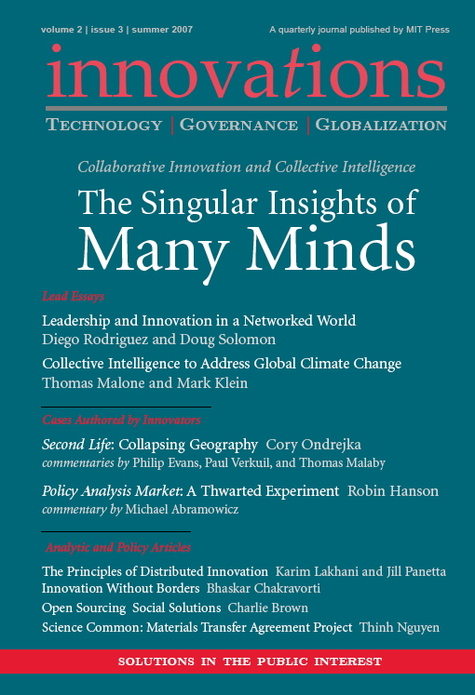
Innovationscover

I recently had the great pleasure of writing this article with Doug Solomon.  Titled "Leadership and Innovation in a Networked World", and published by the MIT Press’s innovations journal,  this essay takes a look at what’s happening to the state of the art of getting stuff done in a world where having meaningful interactions with people via things like Google Docs, iSight video cameras, and yes, even World of Warcraft, has become an everyday reality.  Here’s the heart of the article:

Unfortunately, by seeking the rare brilliance of a limited few instead of the statistically likely success of the connected many, the “lone genius” worldview has limited our ability to make meaningful progress in everything from technology, to organizations, to education, and all the way to society. We’ve done very little to systematically develop technology to support the innovation process. Overall, we are still in the “horseless carriage” days of living in a truly networked world. We can do better, but how do we begin to engage this new way of being? We believe a path to the future can be found by paying conscious attention to evidence of what works in the world today, and by asking the following questions as we work:

  • What are some of the enabling collaborative tools available today?
  • What lessons can be learned from organizations doing networked innovation?
  • How do things get done in a networked world?

Writing this essay was a chance to learn by doing.  Though Doug is a colleague of mine at IDEO, and we sit in the same building, we almost never see each other because we’re always off cranking on some interesting, but separate, project.  That, plus the fact that we’re both crazy busy, led us to use Google Docs to help us write the article in a collaborate way.  We began the essay at 11pm in the lobby of a hotel after the first day of the Fortune iMeme conference, and then proceeded to write it whenever we each had time.  For me, that meant waking up at 5am on a Sunday for some quiet working hours, or writing a few lines while sitting, delayed, on the tarmac at DFW.  Over 744 (!) revisions later, Doug and I had what I hope passes for a coherent essay, and during all those days of writing, we only worked face-to-face two or three times.  There’s something to this technology-enabled collaboration stuff.

Where’s your place for failing?

I heard this statement expressed the other week while walking around the campus of a thriving business:

                "This is the building where we do failure"

A very simple statement, but very deep.  It referred to a building dedicated to the support of prototyping behavior.  In other words, a place where people are encouraged to craft probes in to the future, each designed to bring back a bit of evidence meant to guide decision making.

What I also found significant about this place is that it is open to anyone.  It’s not a special lab or skunkworks for a select group of people.  Anyone can walk in and do failure.  I think this is an important kind of resource to have available if your organization is serious about engaging in innovation on a routine basis, whether that innovation be incremental or evolutionary in nature.

There’s a Field of Dreams aspect to having a place designed for failure.  You have to believe.  In particular, three points of belief are key to sustaining a place for failure, otherwise it won’t get used in the right way or even understood:

  1. You can prototype anything
  2. You can prototype with anything
  3. Failure sucks, but instructs

At the end of the day, having a place responsible for the creation of variance, fueled by intuition and experimentation and optimism, is key to making failure instructive and productive.