metacool Thought of the Day

"To create is to potentially embarrass oneself in front of
others. It is about the courage to be oneself and to be seen as
oneself. Putting ink to a page, or pressing one’s fingers against clay,
or typing a line of computer code, or blowing glass and realizing
mistake. Or success. With everyone watching. But most importantly, you.

So it dawned upon me how important it is to be creative. Because
it means you have within you infinite capacity to experiment. You are
unafraid to go somewhere new because you are creating a new thought
process about your own creativity. You know that if you stop and no
longer challenge yourself, you cease to be creative. You become still,
silent, and the bow no longer connect with the strings and music is not
made. And you do not exist. You show you do not have the courage to
exist.

Creativity is courage. The world needs more fearless people that can
influence all disciplines to challenge their very existence. Creativity
is reflection aimed not at yourself, but at the world around you."

–  John Maeda 

Creativity and the Role of the Leader

Last year I participated in a Harvard Business School colloquium titled Creativity, Entrepreneurship, and Organizations of the Future.  I had a great time contributing to the conversation there and learned a lot, too — in other words, it was a classic HBS experience (I really love the place).

The October issue of Harvard Business Review has a summary of the colloquium written by professors Teresa Amabile and Mukti Khaire.  It is titled "Creativity and the Role of the Leader", and it’s available for free right now on their site.  I’m quoted in it, and so is my blogging and teaching buddy Bob Sutton, among others.

Here’s my favorite portion of the article:

By the colloquium’s end, however, most attendees agreed that there is a role for management in the creative process; it is just different from what the traditional work of management might suggest.  The leadership imperatives we discussed, which we share in this article, reflect a viewpoint we came to hold in common: One doesn’t manage creativity.  One manages for creativity.

What do you think?

Making green red: the ALMS Green Challenge

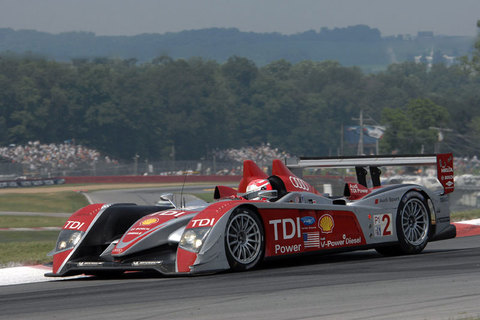
Audi_on_track_2_lg

This past weekend I watched some fantastic racing at Road Atlanta courtesy of the American Le Mans series.  Audis were dicing with Peugeots, Ferraris with Porsches, Porsches with Acuras, and Corvettes with Aston Martins, among other marques.  All of it awesome, technology-centric racing put on by the American Le Mans Series (ALMS).

What made this particular running of Petit Le Mans unique was the debut of something called the Green Challenge.  An innovative behavioral incentive program developed jointly by the ALMS, the US Department of Energy, the Environmental Protection Agency, and the Society of Automotive Engineers, the Green Challenge allows racing teams to score points for sheer speed and for energy usage and carbon footprint.  Teams are evaluated on the total greenhouse gas life cycle of the fuel type they use in the race, which could be cellulosic ethanol, bio-diesel, and ethanol/petroleum blend, or a hybrid internal combustion/electric source.  For the gearheads among you, the following formulas are used to evaluate Green Challenge performance:

  • Performance Energy Coefficient (the amount of energy used):  [total normalized fuel consumption during race] \ [1,000,000]
  • Greenhouse Gas Coefficient (the amount of greenhouse gases emitted): 3 * [ (upstream C02) + (downstream C02)]
  • Petroleum Fuels Displaced: Y * [ (upstream petroleum energy) + (downstream petroleum energy)]

As a general rule, competition is good for spurring on innovation.  From high-minded endeavors such as the X PRIZE, to the (very scary) technological leaps seen during WWII, high stakes seem to breed a combination of focus and access to resources which help support innovative behavior.  In the parlance of Ways to Grow, competition helps set the context for revolutionary innovative outcomes.  To that end, here’s what Margo Oge, Director of the Office of Transportation and Air Quality at the EPA, has to say:

Automobile racing spurs innovation in safety, performance, and now, we are happy to say, clean technologies.  Racing is the ultimate test track.

Amen.

I admire this high-minded, innovative approach on the part of the American Le Man Series.  Rather than take a pessimistic, let’s do less-bad approach to racing — which would have gone in the direction of greatly restricting fuel consumption, which is terrible for competition — they chose to pursue an optimistic, pro-fecundity and consumption approach to being green.  As Bill McDonough has shown us, we can make a paradigm shift to a system where inputs and outputs flow in ways that enable consumption without harming our environment, rather than assume that all consumption must trigger an increase in entropy. This initiative is only the tip of the iceberg, but it is a fantastic start.  I tip my hat to the leadership of ALMS.

And the title of this post?  It refers to an article I wrote for NZZ Folio a year ago, called  Who will be the next millionaire?  My point then was that we need to find ways to go green while going red, which is my code for maintaining our ability to enjoy things that are sexy, fast, and cool.  I still believe this is true, and that we are in the early days of making green tech and clean tech sexy.  This is one of the reasons behind my new blog Unabashed Gearhead Gnarlyness — it’s an exploration of what makes red red.

For those of you who didn’t catch the race, here’s the last lap.  Allan McNish is a hero, a pure racer.  Here is a drive worthy of the great Nuvolari.  Very inspirational stuff:



Design thinking in the New York Times

The New York times ran a great article yesterday called "Design is more than packaging".  Of course, if you’re part of the metacool community, you already know that.  But it is great to see this meme getting out there and sticking.  I’m very happy to see that the article was published in the Business section.  Cool!

Among others, the article mentions IDEO, my employer, and the Stanford d.school, my other employer.

A couple of quotes.

Tim Brown:

Design thinking is inherently about creating new choices, about
divergence.  Most business
processes are about making choices from a set of existing alternatives.
Clearly, if all your competition is doing the same, then
differentiation is tough. In order to innovate, we have to have new
alternatives and new solutions to problems, and that is what design can
do.

George Kembel:

It would be overreaching to say that design thinking solves
everything. That’s putting it too high on a pedestal.  Business thinking plus design thinking ends up being far more
powerful.

Well put, gentlemen!

A remarkable wish

At TED in 2007 I heard TED Prize winner James Nachtwey say:

"I’m working on a story that the world needs to know about.  I wish for you to help me break it, in a way that provides spectacular proof of the power of news photography in the digital age."

Tonight his wish comes true.  You can go to www.xdrtb.org to see more.  These photos will be seen across the world tonight when they are projected in 50 different cities.

“Thank you”, not “Hey you!”

A pleasant surprise showed up a few days ago in my mailbox: the October edition of one of my favorite magazines, Monocle.  I wasn’t expecting to see this issue because I mistakenly allowed my subscription to lapse. 

A second surprise awaited me when I opened up the shipping wrapper (Monocle ships in a protective packet):

Cimg3273

As you can see, a paper flap was tucked in to the cover.  Here’s what this paper flap said when opened:

Cimg3274

When it comes to caring about all the little things that add up to a superior experience, this little flap is extremely telling of the care that has been poured in to the Monocle brand.

First, its language and form are consistent with the brand voice used across rest of the publication.  Who wrote it?  Likely a member of the editorial staff.  The tone and the layout read just like anything else branded "Monocle".  Most magazines forget their voice when it comes to this, the most personal of communications they ever have with a subscriber.  In this situation, why would you speak to anyone in anything other than the editor’s very best voice?

Second, the content is not sales content.  It is relationship content.  They’re speaking to me as an adult.  No weird offers, no tricky language.  No shouting.  No desperation.  Unlike many magazines, which start bugging you to renew months before the end of the subscription with exaggerated offers and wacky incentives, this statement is gracious, factual, pleasant, business-like, and polite.  Just the same as everything else at Monocle — which is the point of having a brand in the first place.

Everything matters.