
Seth Godin at metacool: Design & Authenticity

Seth Godin is gracing the pixels of metacool today from The Business Blog Book Tour to talk about creating cool stuff, remarkable stuff, and his new book All Marketers are Liars

I’ll be posting Seth’s answers to my questions over the next few hours, so let’s get started, and be sure to check back later for more of his thinking.

metacool:
Can a good story be used as a substitute for bad design? Many of
the examples in All Marketers are Liars communicate their story through good design, from message to product to package. Does a good story make up for lousy aesthetics and/or functionality?

Seth Godin:
A story is worthless without authenticity. You can’t say, "Well, this
was designed by Phillipe Starck, therefore it’s easy to use," and
expect that to work if, in the long run, people hate using it. Sure,
some people will fall for it, but what really delivers is something
like OXO. The OXO design is totally overdone, emphasizing at every turn
just how USEFUL this must be. But it IS useful! So the story works.

There are plenty of products where bad design is part of the story. The
Drudge Report, say, or the Hummer.
Beausage

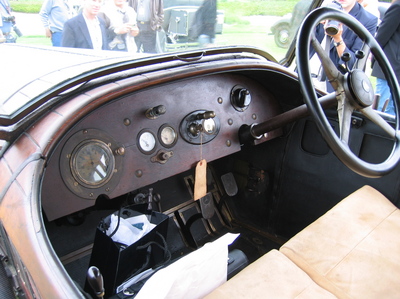
I’d like to tell you about a new aesthetic term called "beausage".  It sounds French but it’s not; instead it’s a synthetic combination of the words beauty and usage, and describes the beauty that comes with using something.

Metacool1914mercedes

Beausage is:

  • Roman amphitheater steps whose faces are worn away by the tread of thousands and thousands of shoes
  • Stone chips on the hood of a Ferrari 250 which has been run hard and put away wet
  • A bike seat whose adapted form reflects that of its owner’s posterior
  • The look and feel of the cockpit of the old Mercedes pictured above (a jumble of replacement gauges and parts, obviously used a lot) — that’s 91 years of beausage!

How, you may ask, is beausage any different than patina?  Well, it’s certainly related, but different.  Patina is really more about surface level changes happening at a chemical level: oxidation, chemical stripping, and so on.  Beausage describes changes that happen in 3D where atoms get torn and stripped away, as occurs with scratches, tears, chips, and wear marks.  I used to say "patina" when what I really meant was "beausage".  It’s nice to have both.

I wish I could say I coined it, but the term beausage is the brainchild of Grant Petersen, grand pooh-bah of Rivendell Bicycle Works and probably the single most brilliant, holistic, and intuitive brand creator out there.  I mention Grant not only for intellectual attribution, but because he’s going to help us bring this back into the world of creating cool stuff.  Grant states that "In general, real materials develop beausage, and synthetics look like old junk.  It’s like a cowpokes’s old denim jacket, versus an old polyester leisure suit…". 

Beausage is something for all products and their designers to aspire to.  When the chrome on the back of my iPod scratched away, the resulting exposed grey plastic made the thing feel cheap and ephemeral — the opposite of what a good chrome finish should have done.  Imagine an iPod that looked better (beausage) the more it got used.  When you start to conceive of finishes not as veneers but as reservoirs of meaning via beausage, then you’re giving your customers something that will continue to provide satisfaction through the ages.

metacool Thought of the Day

"It’s the vehicle’s design that first forges that emotional bond between product and consumer… So often it simply boils down to this:

‘Do I like the way this car looks or not?’ 

And I think that’s part of the reason this industry is headed for a new golden age of design. That’s great news for all of us who dream about beautiful cars and trucks. It makes it a very exciting time to be in this business. Because we’re getting back to what it’s all about: Building the stuff that dreams are made of."

Bob Lutz

Venture Design, part 7

In an effort to resuscitate a riff about venture design that I wrote about a few months ago, I’m going to point you (and myself) to this nice Bill Breen Fast Company piece about design thinking, Roger Martin, and the Stanford d.school.  Here are two paragraphs I particularly like:

The trouble is, when confronted with a mystery, most linear
business types resort to what they know best: They crunch the numbers,
analyze, and ultimately redefine the problem "so it isn’t a mystery
anymore; it’s something they’ve done 12 times before," Martin says.
Most don’t avail themselves of the designer’s tools — they don’t think
like designers — and so they are ill-prepared for an economy where the
winners are determined by design.

And:

Organizations that embrace a design-based strategy also employ the
practice of rapid prototyping. Whereas conventional companies won’t
bring a product to market until it’s "just right," the design shop is
unafraid to move when the product is unfinished but "good enough."
Designers learn by doing: They identify weaknesses and make midflight
corrections along the way.

The subtlety here is that "design shops" don’t typically ship products, they only create them.  The trick is to create a culture within a product organization that is willing and able to ship products that are only "good enough", as this is the enlightened path to creating products that are "wow".  I think this may require having design thinkers working across every discipline in the organization — finance, marketing, sales, service, manufacturing, engineering, etc…  one needs to design a venture that can only be staffed with design thinkers.  I’ll be revisiting this topic as I get into Dan Pink’s new book.  Stay tuned.

On Authentic Lies

159184100301_aa400_sclzzzzzzz__1I just finished reading Seth Godin’s All Marketers are Liars, an ode to the art of crafting, telling, and transmitting authentic stories (or lies).  Seth was kind enough to set me up with a galley of his new book, and if you have even one iota of interest in storytelling as a tool to create good stuff, put this one on your reading list. 

But, you may ask, is Liars really about design?  Yes.  Think of it as Purple Cow II: if Purple Cow was about mindfully applying visceral, behavioral, and reflective design to create remarkable offerings, then Liars is an extended riff upon the subtle art of reflective design alone.  Reflective design is about creating meaning, and in Liars Godin offers a design process to help make your stories sing.  As usual, you always know where Seth stands on an issue, and as a result the stories he tells, such as one about the genesis of Fox News, are engaging and instructive all at once.  The companion blog for the book is nifty, too.