metacool Thought of the Day

"NetGens think of the computer as a door, not a box.  When they are on,
they have 5-7 IM windows open and multiple tabs into different
communities. Each community provides a way of being, to express facets
of their identity while engaging in an activity. Most activities are
centered around objects to spin stories and hold conversations. They
don’t go to places, it’s more likely they augment plazes in the real
world. With increasing mobility they tap groups for what they need to
get done no matter where they are and make where they are matter… In other words,
the web is increasingly less about places and other nouns, but verbs."

Ross Mayfield

Design Thinking on Ice

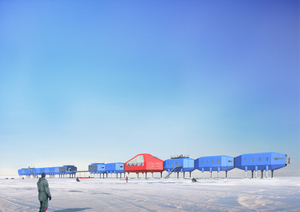
External_view_01
Could this be the oft-rumored winter under-ice exploration HQ of Team Zissou?  Or perhaps the Banzai Institute’s secret computational genomics R&D lab?

Nothing so cool.  But on the other hand, something designed with surviving the cool as a key consideration.  Or in this case, being in Antarctica and not getting buried by it.

For this is Haley VI, the latest in a series of Antarctic research stations created by the British Antarctic Survey.  Haley VI is an extremely clever answer to the question, "How should humans live in the cold?".  Among other things, it features:

  • A modular architecture which allows multiple units to be combined and recombined
  • Renewable energy supplies
  • A thoughtful approach to dealing with doo-doo
  • Ski stilts which enable the module to avoid burial by layers of snow by being towed away

It’s a good example of the holistic nature of design thinking at work.  A traditional, building-centric worldview would have responded to the challenge of snow burial with a "build it stronger and heavier" dictum, because buildings can’t move, right?.  But Haley VI shows us that sliding modules gather no ice, and that’s a breakthrough informed by a fundamentally optimistic view of the world: slide a building across the ground in the middle of nowhere, then snap it to another modular building?  Let’s build it!

And you just gotta love the clubhouse module – it’s enough to start an Antarctic housing bubble:
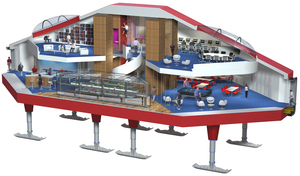
Central_module_iso_1


metacool Thought of the Day

2005_yzfr1_photo_07_tcm2650996

"To be successful in motorcycle product planning, you need to have enthusiasm and at the same time you need to have an enormous curiosity to dig deeper and see what’s behind people’s motivation, combined with an open mind for creativity. It is a difficult balance between logic & facts and creativity & vision. I believe you either have this ability or you don’t. Just like a good painter, you either have the ability to make great paintings or you don’t. This job requires a lot of intuition, which one cannot learn from schoolbooks."
Masahiro Inumaru

Design Manifestos: The Cathedral and the Bazaar

This is start of a new feature of metacool, which I’m calling Design Manifestos.  These are pieces of design thinking that really had (or continue to have) a big impact on my own thinking.  Longer than a Thought of the Day, many more words than an Unabashed Gearhead Gnarlyness entry.

A great place to start is Eric Raymond’s The Cathedral and the Bazaar, a wonderful essay about the "bazaar" (AKA "open source") approach to creating cool stuff.  Please do read it, but in case you can’t, here are my favorite bits: 

  • "…you often don’t really understand the
    problem until after the first time you implement a solution. The
    second time, maybe you know enough to do it right. So if you want to
    get it right, be ready to start over at least once."
  • "…I think Linus’ cleverest and most consequential hack was not
    the construction of the Linux kernel itself, but rather his invention
    of the Linux development model."
  • "Release early. Release often. And listen to your customers."
  • "Given enough eyeballs, all bugs are shallow…  In the cathedral-builder view of programming, bugs
    and development problems are tricky, insidious, deep phenomena.
    It takes months of scrutiny by a dedicated few to develop confidence
    that you’ve winkled them all out. Thus the long release intervals,
    and the inevitable disappointment when long-awaited releases are not
    perfect.  In the bazaar view, on the other hand, you assume that bugs are
    generally shallow phenomena – or, at least, that they turn shallow
    pretty quick when exposed to a thousand eager co-developers pounding on
    every single new release. Accordingly you release often in order to
    get more corrections, and as a beneficial side effect you have less to
    lose if an occasional botch gets out the door."
  • "Often, the most striking and innovative solutions
    come from realizing that your concept of the problem was wrong."
  • "I think it is not critical that the coordinator be able to originate
    designs of exceptional brilliance, but it is absolutely critical that
    the coordinator be able to recognize good design ideas from others."

These are great thoughts about the process of creating good stuff.  It’s important to keep in mind that this isn’t just about software.  The challenge is to figure out how to make the bazaar part of your own way of getting things done.

metacool Thought of the Day

"Is having ideas considered design? … I
would argue no. The idea is not the design. Only an embodiment of the
idea is design. It is this important distinction that people so often
overlook in organizations as they work on what they want to bring to
market next. Everytime ideas are debated verbally, an organization
wastes resources."

Chris Conley