Director’s Commentary: Lexicon of Auto Shapes

Ever wonder what tumblehome is?  Ever wonder why you’ve never wondered what tumblehome is?

The New York Times is running a nice interactive graphic which shows and defines the terms which form the basis of an auto designer’s aesthetic vocabulary.  Strictly speaking, since there’s no designer speaking here, this isn’t exactly a Director’s Commentary; it’s more like a commentary on commentaries. 

Zero tumblehome?  A Land Rover.  Massive tumblehome?  A Pagani Zonda (whose factory is a great place to visit, by the way).

And the car in the NYT’s diagram?  A Saturn Aura, proof of the resurgence of their brand.  Good stuff.

Sound Matters, part 3

We live in a wonderful age where digital controls add another layer of life and complexity of behavior to analog devices such as the Renault Formula 1 motor above being played like a choir using a computer to control the rpms (the fun starts with 32 seconds left in the video).

Why must things sound boring or terrible?  Why not design them to sound the way they would sound if you stopped and thought about the right sound for the occasion? You know that ominous landing gear whine and clunk you hear right after take off in a jet liner?  Why not make that sound confidence-inspiring?  Everything can be designed, and to deliver a total experience, probably should be.

metacool Thought of the Day

"There was a time not so long ago when egomaniacs made media to their own personal standards, and when you make something for yourself, it will always be far better and more honest than something you make the please the marketplace.  With computers, individuals can be egomaniacs and make the media they think is good."

Tibor Kalman, as quoted in Wired magazine, December 1996

Double Stinting

Talladega15

I’m double blog-stinting this week.  Along with my fellow guest bloggers David Hornik and Bruno Giussani, I’ll be over at TEDBlog for the week writing posts on a daily basis. 

Actually, I’m always double stinting in that I’ve been a guest blogger for TED over the past year.  One of my recent posts talks about whooping it up with Toyota in NASCAR, and another one is a march through my daily life in search of my Starck Factor.   

In case you are wondering, no, I didn’t receive any hate mail for daring to talk about NASCAR in the same sentence as TED.  Honestly, I think NASCAR is a great example of what happens when technology meets entertainment meets design in a premeditated fashion.  It may not be your cup of tea – or it might be your can of Bud – but it is obviously working, so why not learn from it?  One of my goals for 2007 is to make it to a NASCAR race.

But do please check out the TEDBlog this week.

Introducing Creating Infectious Action, Kindling Gregarious Behavior (CIA-KGB), to be taught starting in April at the Stanford Hasso Plattner Institute of Design at Stanford

Wow, what a lot of fun that namestorm was!  The "KGB"  names are still rolling in, and I have to say there was some very creative thinking going on (see Reilly’s comments on the previous post below).  The winner is Kindling Gregarious Behavior, because it sounds good, actually describes the content and aim of the course (not a bad thing at all when you think about it) and — best of all for me — it echoes the observation that Wikia CEO Gil Penchina made on a panel I hosted at last year’s AlwaysOn conference.  Gil made the point that, instead of spending all your time, energy, money and luck building a big bonfire on your own and then hoping that a bunch of other people will choose to come and sit around it, why not identify all the myriad little campfires burning around you and pour a little gas on each one?  That’s the way infectious action and gregarious behavior get fed.  It’s not about some big top-down mission, though centralized thinking matters.  It’s about embracing the power of the community.  It’s about kindling.

Anyway, I’m really excited to be teaching CIA-KGB along with a truly fabulous — FABULOUS! — teaching team.  We learned a lot teaching CIA last year (and got lots of great coverage in BusinessWeek and other august journals), so this year we’ve made some tweaks to the class to try and make it an even better experience.  This year’s class will again involve a creating infectious action project for the good folks at Mozilla, and will then focus on a project for Global Giving.  I’m very excited to be working with Global Giving, and it already feels good to be brainstorming project ideas with my Mozilla friends.

This will not be your usual classroom experience.  Everything is real, everything is open-ended, and the sky is the limit.  It’ll be scary.  It’ll be fun.  It’ll be something, hopefully, which knocks your hat in the creek.  As if all that weren’t enough, it looks like Global Giving will be supporting some summer internship positions for CIA-KGB students who A), kick butt in the class, and B) want to keep working on Global Giving-related issues.  How cool is that?

Are you a Stanford student with Master’s standing?  Please consider applying for the course.  You can find an application hereIt’s due March 9, and we’ll be selecting 24 people to part of the CIA-KGB classroom community.  The journey is the reason we do all of this, and the fruit of the voyage will be more experience with the design thinking process as well as further developing methodologies for creating infectious action and kindling gregarious behavior.

Unabashed Gearhead Gnarlyness


The Saab 96

I’ve always wanted one.  Growing up in Boulder as a lad in the Ford + Carter years, I saw them everywhere.  An ubiquitous presence on the aesthetic landscape.  I just assumed that a third of America drove a Saab 96 or 95.  Along with bobbing Citroen DS21’s, snorty BMW 2002tii’s, prim and proper Volvo Amazons, and some wickedly Mothra-like ur-Subaru’s, the Saab 96 was the car of choice for all the forward thinking 1970’s pseudo intellectual and non-pseudo intellectual hippies who inhabited (and still inhabit) my hometown.  Each day on my trudge to and from elementary school I’d stop and goggle an off-white 95 wagon, marveling at its bulldog proportions and vestigial tailfins.  "Why?," I wondered.  "Why not?" I now realize, was the answer.

It’s a design classic.  Penned by Sixten Sason, it built the Saab brand by winning rallies the world over, its little two-stroke heart beating away pop-pop-poppoppopopop-pop in freewheeling gravel drifts through dark forests.  Of course the brand lost its way, as most great brands do when they become exercises in linear, rational corporate thinking.  Too bad Subaru is the new Saab, but thank goodness Subaru is the new Saab, too.

Long live the 96!

Director’s Commentary of the Week: Joshua Prince-Ramus

Here’s a fantastic Director’s Commentary from architect Joshua Prince-Ramus.  It’s a video of his talk from TED2006, and it he provides an eye-opening look at the design process which has created works such as the Seattle Public Library, among others.  Three interesting threads are woven in to his commentary:

  • The notion of employing a "hyper-rational" design process in the name of creating emotionally resonant experiences and spaces.
  • Using a team-based design process, rather than the more traditional "star designer" model often found in architecture and industrial design.
  • Designing for business by using flexible spaces to enable economic viability now and in to the future.

The storytelling is great.  If you can, it’s easily worth the twenty minutes you’ll spend.  This is how innovative behavior looks and feels and happens.

What’s Authentic?

Hist2_wht

Whenever I think about designing something to have a better chance of being contagious, the issue of
authenticity invariably comes up.  All things being equal, we’re more likely to tell people about the authentic things in our lives.  When was the last time you joined a cause because it was hollow, shallow, and fake?  Authenticity matters.

But, what is it?  I know it when I see it, hear it, feel it — but what is it?   And can it be designed?  Or does the act of designing it break it?  In other words, can an authentic experience of Paris-ness be designed, or does a designed version of Paris end up feeling a lot like Paris in Las Vegas?  Perhaps a way to answer the questions of "what is it?" and "can we design it?" is to borrow a page from the book (or blog?) of John Maeda and endeavor to come up with principles of authenticity.  If we can come up with design principles for authenticity, then we’ll have a better understanding of what makes for authentic experiences, as well as the means to design them in a more predictable manner.

The first design principle I’d like to discuss is the idea of a strong point of view.  Authenticity, it would seem to me, demands a strong point of view.  In other words, a clear sense of what matters.  The ability to make choices.  A deep understanding of what you are and are not.  What does a strong point of view look like?  A great example is Jitensha Studio, a Berkeley bicycle shop run by Hiroshi Iimura.  Last year the New York Times ran an evocative profile of Jitnesha which contained this ode to a strong point of view from Mr. Iimura:

If a customer wants a component that is not to my taste, I refuse.  No brightly colored seats. No neon.
Nothing flashy, nothing impractical.  I have to satisfy my own tastes first.

A strong, coherent vision of where things need to go is the bedrock of authenticity, I’d argue.  Porsche was a more authentic brand when Porsche was run by a Porsche whose opinions about Porsche-ness could trump any marketing study.  Apple is all about a clear point of view, and it’s certainly the most authentic manufacturer of consumer products out there today.  Anything Virgin is about an authentic experience of what it feels like to be irreverently original.  And so on and so forth.

Thoughts?  Am I full of it?  What are some other possible principles?  Should we catch this train?

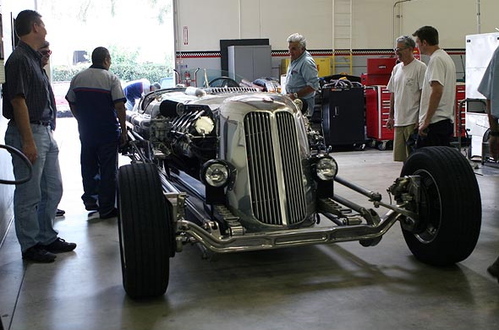
Director’s Commentary of the Week: Gale Banks Turbocharges Jay Leno’s Tank Car

Lenotank

Here’s a Director’s Commentary which is all about ingenuity.  My previous Director’s Commentary pointers about the Honda Ridgeline and the Nintendo Wii have been built around the theme of being human-centered in one’s design process; this one is all about engineering a unique solution for a single human and his singular pursuit of gearhead gnarlyness.  That human goes by the name of Jay Leno.  Simply put, he has a custom hot rod powered by a vintage tank motor

A tank motor!  If you’re like me, you have no idea of the operating parameters of a tank motor.  Well, here they are:

  • weight: 2000 pounds
  • swept volume: 1,790 cubic inches
  • number of cylinders: 12
  • power: 810 hp
  • torque: 1,560 lb-ft

That, my friends, is a one huge motor.  It’s designed to accelerate heavy things quickly.  But any hot rodder, particularly one like Jay Leno with some discretionary income, just can’t leave well enough alone.  So he took his tank car to the legendary Gale Banks and asked him to double the horsepower.  DOUBLE THE HORSEPOWER.  As in, 1,600 horsepower.  Which is roughly equivalent to four Corvettes or six Camrys  (yes, we live in the age of the overpowered Camry.  I have a rant to write about this, but that’s for another day).

This Director’s Commentary, then, is about the ingenuity and workmanship that goes into pulling off something extremely tricky from a technical standpoint.  It comes in four parts with lots of great illustrations and stories (look for the one involving Colin Powell), and is full of interesting passages, such as:

The AV 1790 V12 has a long rotating shaft
across the front of the engine to link the carburetor throttles
together. We’ll fabricate new throttle pull-rods to utilize the
original cross-shaft. In this photo the two right bank magneto covers
(there are four magnetos) have been removed. Although we could have
converted the engine to electronic ignition, Gale wanted to retain the
magnetos to maintain the period look.

Yes, I realize that this particular edition of Director’s Commentary probably doesn’t have the wide design thinking appeal of some of the earlier episodes.  But even if you don’t enjoy the technical virtuosity at work here, I’d encourage you to peruse the four episodes.  Perhaps they’ll help you better understand why people like me find this stuff so interesting.  If you happen to work with, or manage, or lead people who like gearheady content, it may help you gain insight in to ways to help those people be happy and innovative.  And embedded here too, unfortunately, is a lot of the human wiring which makes some us buy Hummer H2’s when what we really needed was a minivan.  Or perhaps even just a Camry.  So much of why we pursue technological wizardry, whether it be of silicon or aluminum or clever bits and bytes, is driven by emotional and our irrational inner dialogs.  If we’re going to get better at designing systemic solutions to address climate change and other broad issues facing our societies, we need to really understand what drives people to create 1,600 horsepower hot rods. 

And overpowered Camrys.